
)
News: Utility innovation, EV adoption, and digital twins define the 2025 Grid Changers
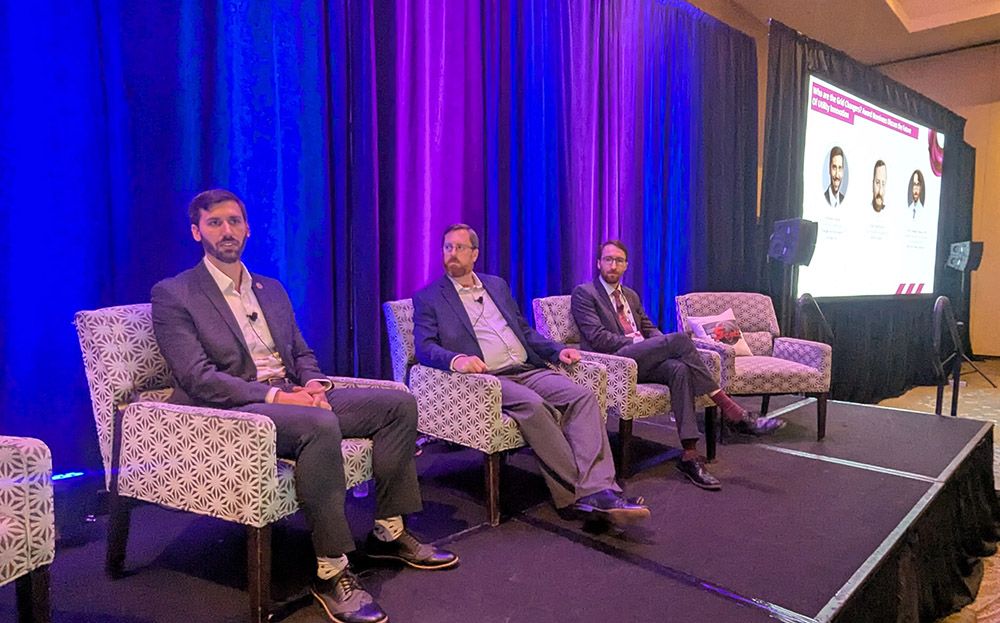
From left to right: Andrew Farrell, Ryan Hawthorne and Victor Daldegan Paduani. Photo courtesy Jeremiah Karpowicz
What makes a project worthy of celebration by the wider utility industry? Who are the people that enabled such ambitious initiatives? And what larger lessons can the industry learn from them?
These are just a few of the critical questions that 2025 Grid Changers nominees answered during the “Who are the Grid Changers?” panel that took place on November 18th, 2025, at DTECH Northeast. The awards themselves were given out at the conclusion of the panel, but the insights and lessons from all of the nominees showcase what it can mean to create and define blueprints that enable the sorts of transformations that are needed across the entire industry.
Increasing the number of chargers for the benefit of everyoneAndrew Farrell is Director, E-Mobility at Orange and Rockland Utilities, Inc. Their POWERREADY Program offers incentives to offset the costs of installing Level 2 and DC fast chargers for businesses, multi-family dwellings, and government entities in the region. While the larger goal was to build out supply ahead of actual demand, the company has already met its goal to support the installation of thousands of chargers, highlighting how much has been accomplished, but also showcasing what sort of opportunities this kind of proactive approach can enable in the short and long term.
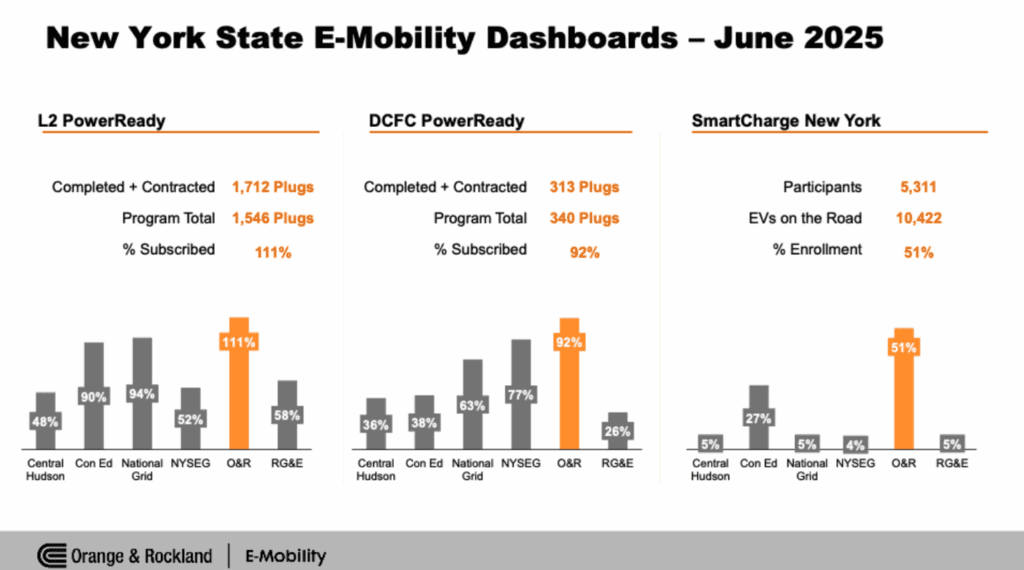
Farrell explained that the goal of the initiative was to increase and accelerate EV adoption that connects with New York’s Climate Leadership & Community Protection Act. Doing so meant shifting the large power draw from EV charging to off-peak hours. This strategy helped mitigate rate increases and freed up capital for other necessary projects like safety and reliability improvements. The benefits can be seen in the bottom line numbers, but were also evident on a much more practical level.
“In the middle of June of this year, we had a heat wave that ended up being a top ten system peak day,” Farrell told the crowd. “An analysis was done to find out what of that was from EVs, and it ended up coming in at 4%. So the question became, what would the peak have been if those charging programs not existed? And it would have been an incremental 3% higher. It really shows these managed charging programs are working.”
Farrell outlined the practical benefits that increasing the number of chargers on streets can enable for utilities, and how the thinking behind doing so should be considered in terms of risk management conversations. A proactive shift in operational planning around the integration of innovations like EVs is what will both ensure system reliability and help avoid even costlier infrastructure upgrades that might be required in the near term.
“For us, 2% of system peak could just materialize overnight,” he said. “So you want to start thinking about those risks.”
Much More than a Transmission ProjectThe H&SB Transmission Project from Central Hudson Gas & Electric is a multi-phase rebuild of a 23.6-mile electric transmission line that was originally built in 1928. The project was designed to enhance electric service reliability by replacing old lattice towers and wires with new steel poles and increasing the line’s voltage capacity, but the project represents much more than a simple transmission rebuild.
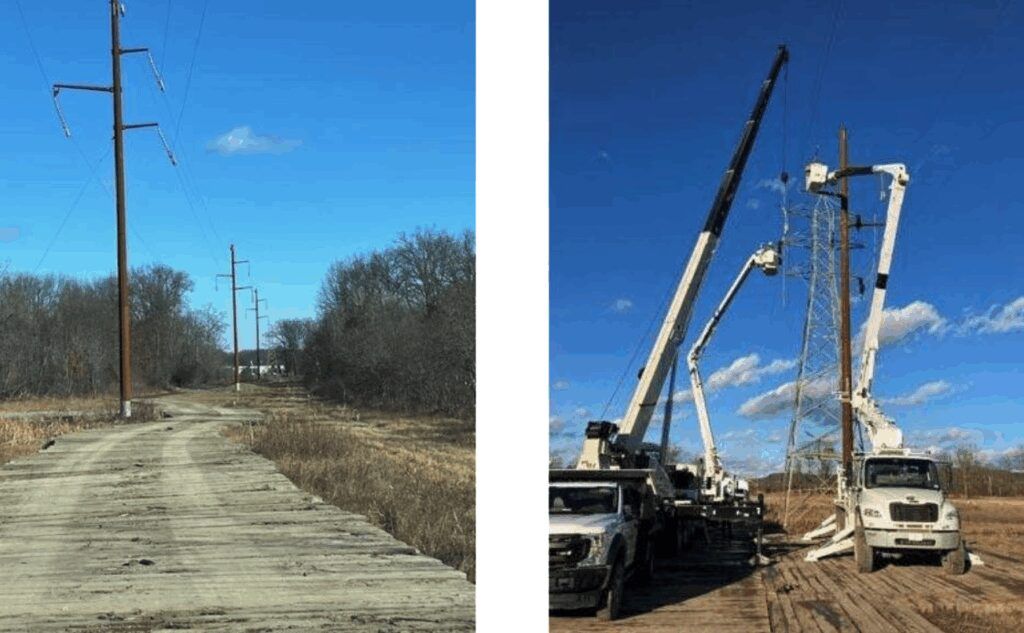
Ryan Hawthorne, Vice President of Engineering at Central Hudson Gas & Electric, discussed the logistics and challenges of the project, as the corridor passes through open space, an active quarry, wooded parcels as well as residential areas. The line is being reconstructed within the existing right-of-way in most of these areas, with a new reroute to avoid an environmentally sensitive area, while both the lattice towers and wires are being replaced along the entire route. It required a different approach that goes beyond mere system upgrades.
“The project demonstrated the value of thinking differently,” Hawthorne explained. “By applying distribution-level automation solutions to solve a transmission-level reliability risk, we’ve been able to keep the power on but also enable improvements.”
To maintain this reliability during the rebuild, the team avoided the traditional, costly method of “live line work.” They leveraged smart switches and electronic processes from its grid modernization program to create an automated contingency solution. This system gives the control center the ability to automatically restore all customers in the affected pocket via distribution system ties with the push of a button, should a line be lost. This proactive measure effectively avoids potential outages, shifting the focus from simply responding to an outage to preventing one. It’s the result of thinking differently that the team further leveraged with other processes.
“We also shifted our project management strategy from separately managing different facets of contractor work to utilizing a single main lead contractor, which manages the sub-contracting pieces,” Hawthorne said.
This approach proved successful in simplifying internal management, moving the risk profile, and is now a model for future large-scale rebuilds.
Beyond a digital twinInitiated in 2017 to meet New York City’s aggressive goals for renewable integration, the Advanced Grid Innovation Laboratory for Energy (AGILe) at New York Power Authority has created a digital twin of the electric grid for the entire state of New York. AGILe functions as a high-fidelity power system laboratory, enabling the testing and rigorous validation of new technologies before costly field deployment.
Victor Daldegan Paduani from the AGILe team discussed the many benefits this model has enabled. The Digital Twin’s unique database allows for the import of ISO data sets and streamlined creation of multiple-year representations and snapshots, making high-fidelity modeling economically feasible. It has also enabled powerful economic modeling, but the full value of the asset is just starting to be unlocked.
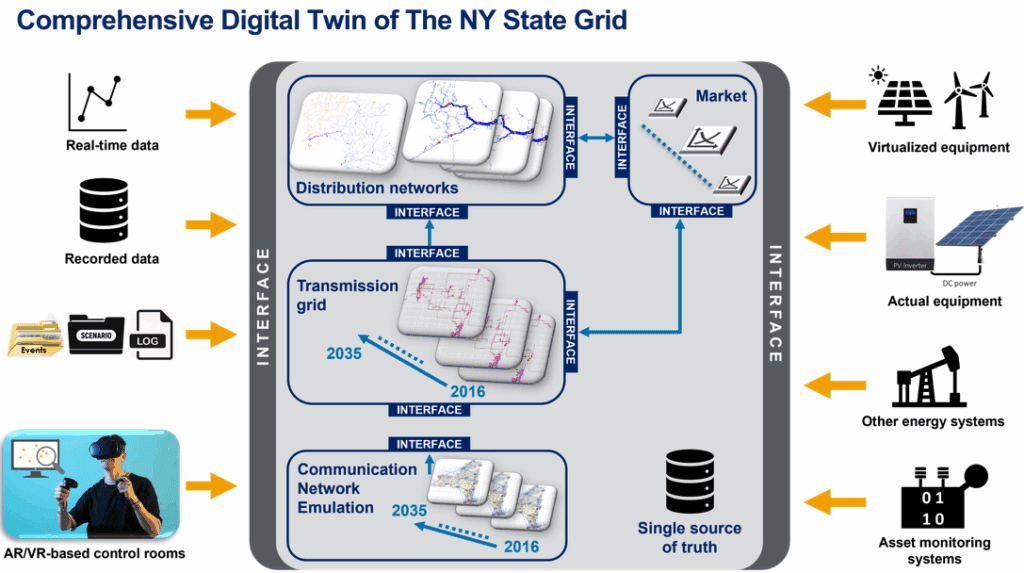
“The platform allows engineers to analyze how events in the distribution network affect the stability of the wider co-power system, which is a significant challenge when transmission and distribution are analyzed separately,” said Paduani. “It also serves as a single source of truth to provide a unified and consistent data source across transmission and distribution, resolving discrepancies that you often see between models used by different groups within a utility.”
AGILe uses real-time simulation where one second of model simulation corresponds to one second of real-world time. This allows engineers to physically interface a device via industry-standard signals, making the device behave as if it were connected to the actual grid. The lab models a facility’s electrical systems alongside its communication networks to allow engineers to safely run cyberattacks in order to observe how cyber events translate to physical issues as well as system-wide vulnerability.
Paduani shared that some of his biggest operational lessons from the project are connected to the way data is both being captured and utilized. He stressed that continuous improvement in data quality is paramount to the success of all AGILe projects, although others can similarly apply these lessons.
“The biggest ongoing challenge is the critical importance of model quality and data quality,” he said. “Flawed models impede the success of studies and create challenges when integrating data from multiple utilities with different standards.”
Grid Changing for othersAll three panelists underscored the critical role of communication, not only across internal teams and departments but also with the general public. Making customers and stakeholders aware of project goals and progress was discussed as being essential for smooth execution and community buy-in.
A major recurring theme was the value of “thinking differently,” which Hawthorne talked about specifically but can also be seen in the POWERREADY Program and AGILe. Taking a proactive approach to EV integration as well as the creation of models that can better define decision making made all the difference to these individual teams, larger utility organizations and the communities they serve.
The strategic investments and tactical execution highlighted by the 2025 Grid Changers are driving the future of the Northeast grid, demonstrating how utilities can create a more resilient, reliable, and sustainable energy future for all customers through innovative operational approaches and a commitment to data integrity.
About the Author
Jeremiah Karpowicz is the Content Director for Transmission and Distribution at Clarion Energy Group, driving the conference development for DTECH events as well as reporting on the energy industry via Factor This. With over a decade of experience as a content strategist and digital leader, he possesses a rare talent for building industry connections that wouldn't otherwise materialize. He's passionate about using content and conversations to expand DTECH's events and publications to new audiences and greater impact. If you'd like to share a story idea or contribute content, you can reach him here.