
)
News: Innovation, processes and people redefine affordability issues for the energy sector at DTECH Northeast
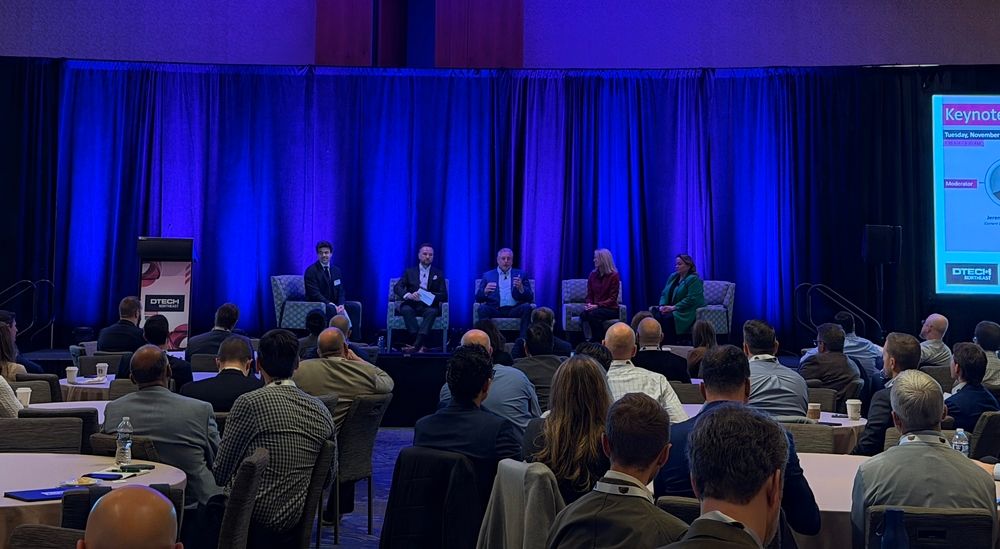
Photo courtesy DTECH NE
The need to embrace new tools and technologies that both enable efficiencies and provide the ability to meet forthcoming energy demand is widely understood across the entire sector. From general AI applications to specific implementations like AMI 2.0, there’s a consensus around what it means to prioritize the adoption of new tools and the latest innovations.
However, that adoption can’t take place in a vacuum and needs to be connected to issues and challenges on both the regulator and customer sides, which is something that was fully explored during the opening keynote at DTECH Northeast. Taking place November 17th–19th, Utility leaders discussed how successful technology adoption requires support from a larger ecosystem, demanding shifts in individual and organizational thinking. This collaborative approach is the best way to meet challenges around reliability and affordability.
Regulatory and Financial DriversFERC Commissioner Judy W. Chang opened the event by outlining the critical regulatory and financial issues shaping the entire energy landscape. Drawing on her expertise in energy economics and policy, Commissioner Chang provided a baseline for grid evolution, highlighting the support required from regulators and talked through some examples around how they’re looking to provide it.
Chang specifically cited Order 2023, which mandates cluster studies and sets financial conditions for projects in the interconnection queue. She also emphasized the importance of cost certainty in resolving the queue and ensuring a resource-adequate grid for the future. She mentioned grid-enhancing technologies (GETs) as an essential means of maximizing capacity from existing systems, but that this transformation ultimately isn’t about a single approach or technology.
“There is a critical need for innovation in the energy space to ensure adequate, reliable, and affordable electricity for all customers,” Chang told the crowd. “We need to be careful about the investments we make. We can’t over-build, but we must meet the challenge of the day. We need to ensure that the cost to consumers is just and reasonable.”
FERC’s mission is to guarantee reasonable consumer rates by protecting competitive practices. This focus on affordability was a central theme for the subsequent keynote panel, which explored the transformation of the sector through technology, process, and organizational alignment.
Affordability, Resource Adequacy, and Public TrustPulling together top leadership perspectives from Avangrid, Rhode Island Energy, Eversource and National Grid, the keynote panel underscored that affordability is a top priority for everyone. A key focus in New England is resource adequacy and the role of utilities in facilitating the timely and efficient interconnection of resources.
Kimberly Harriman, Deputy CEO at Avangrid, talked about the need to move faster to address affordability issues, but doing so requires a unified approach and a shift in thinking. She pointed to recent referendums where infrastructure projects faced public challenges, highlighting how public feedback and perception are making an impact.
“We are seeing New England work as a region across multiple states to build trust,” Harriman said. “We have to look at working together. We have to address the NIMBY (‘not in my backyard’) mentality that prevents construction and ensure we build the right capacity.”
Paul Chodak, Executive Vice President and Chief Operating Officer at Eversource, noted that NIMBY has evolved into NOPE (“not on planet Earth”), highlighting the increasing difficulty of securing project approval. He emphasized that relief comes not just from technology but from a balanced investment across three essential pillars that are ultimately connected to something customers want and need.
“It’s not choosing between innovation, people, and process, Chodak said. “It’s all three. When I dispatch a crew today, the individual needs skills not just in line work, but also in digital control and telecommunications to manage the technology. That’s why continual investment in our workforce is key. Trillions of dollars will be invested in the coming years, and the North Star has to be the customer perspective.”
Driving a Culture of Innovation That Leads to ResultsThat customer-centric view also drives utility leaders’ infrastructure response to extreme weather preparation. Beyond physically hardening assets, utilities are implementing holistic resilience strategies to best prepare for weather events that previously hadn’t been a major concern. Greg Cornett, President at Rhode Island Energy, detailed investments to mitigate flooding risk but also adopt new operational practices.
“From a wildfire perspective, we’re now conducting daily risk assessments, which inform real-time operational decisions in high-risk areas,” Cornett said. “Longer term, we are using advanced mapping to make better planning decisions in areas prone to wildfire risk.”
Chodak acknowledged the utility space’s risk-averse nature can sometimes stop organizations from moving forward with these types of new initiatives, but stressed that innovation requires a willingness to test new approaches. He mentioned if teams and organizations aren’t trying new things on a regular basis, they’re not innovating fast enough in a way that could jeopardize those reliability and affordability issues. He stressed that trying new things isn’t about jeopardizing safety, but is instead about not having a fear of failure, and creating a culture where people actively seek opportunities to innovate.
Enabling that culture can create positive results that make a difference on multiple levels, which is something Lisa Wieland, President at National Grid New England, detailed in a big way. Some of their recent initiatives have successfully balanced grid modernization investment with a focus on customer affordability that have created tangible results for customers across the region.
“We’re in the process of deploying next gen AMI meters across the commonwealth of Massachusetts that will give customers greater insights into their energy usage, where they can look at their usage in 15-minute intervals,” Wieland said. “With an app, they can see details around what’s happening at the appliance levels, to the point that a customer in one of our pilots was able to determine it was their son’s use of a dehumidifier for the entire day that was causing their energy usage to go up.”
Wieland mentioned their work with Sense that allows customers to see what’s happening at this level. Those are specifics were something we detailed with Sense CEO Mike Philips when it comes to what it means to transform the relationship between people, homes, and the electric grid.
Wieland also detailed their investment in FLISR (Fault Location, Isolation, and Service Restoration), which is technology to improve reliability and reduce the duration of power outages. National Grid is in the process of scaling FLISR across the commonwealth and currently have 27% percent of their customers covered and in the last year alone have saved $13.5 million interruption minutes.
These examples highlight how resolving reliability and affordability challenges isn’t just about innovation, but is instead about how new tools and approaches impact established processes and people. A collective focus on each is what’s required to enable collaboration across regulatory bodies, utilities, and customers in ways that will resonate in the short and long term.
About the Author

Jeremiah Karpowicz is the Content Director for Transmission and Distribution at Clarion Energy Group, driving the conference development for DTECH events as well as reporting on the energy industry via Factor This. With over a decade of experience as a content strategist and digital leader, he possesses a rare talent for building industry connections that wouldn't otherwise materialize. He's passionate about using content and conversations to expand DTECH's events and publications to new audiences and greater impact. If you'd like to share a story idea or contribute content, you can reach him here.